The Hidden Danger Below Your Pool Deck
Of all the types of pool leaks, underground plumbing failures are arguably the most difficult to detect and the most damaging if left unaddressed. The pipes that carry water from your pool to the pump, filter, and heater — and back again — are buried under your decking, your lawn, and compacted soil. When one of those pipes develops a crack, a failed joint, or a pinhole from corrosion, the water doesn't announce itself. It simply soaks into the earth, week after week, eroding soil, undermining concrete, and adding hundreds of dollars to your water bill before you ever notice something is wrong.
At Reseda Pool Leak Detection, underground plumbing leak detection is one of our most requested services across Reseda, Northridge, Winnetka, and surrounding communities. Here's what you need to know about why these leaks happen and how we find them without guesswork.
Why San Fernando Valley Pools Are Especially Vulnerable
The San Fernando Valley's climate and geology create a particularly challenging environment for underground pool plumbing. Several factors combine to accelerate pipe failures in this region:
- Expansive soils: Much of the Valley sits on clay-rich soil that swells when wet and contracts dramatically during drought. This constant movement puts stress on buried pipes, especially at joints and bends, causing fittings to separate or crack over time.
- Drought and re-saturation cycles: Extended dry periods cause soil to shrink away from pipes, allowing them to shift. When rains return or irrigation resumes, the sudden re-saturation can cause rapid ground movement that further stresses plumbing connections.
- Aging infrastructure: Many San Fernando Valley pools were built in the 1960s through 1980s, when galvanized steel pipes or early-generation PVC formulations were standard. These materials have reached or exceeded their service life and are far more prone to corrosion, brittleness, and joint failure than modern plumbing materials.
- Root intrusion: Mature trees are a hallmark of established Valley neighborhoods like Encino and Tarzana. Root systems actively seek moisture and can infiltrate pipe joints over decades, causing cracks and blockages.
How We Detect Underground Pool Plumbing Leaks
Our pool plumbing leak detection process is designed to isolate the exact location and severity of a buried pipe leak before a single shovel breaks ground. Here's how it works:
Step 1: Pressure Isolation Testing
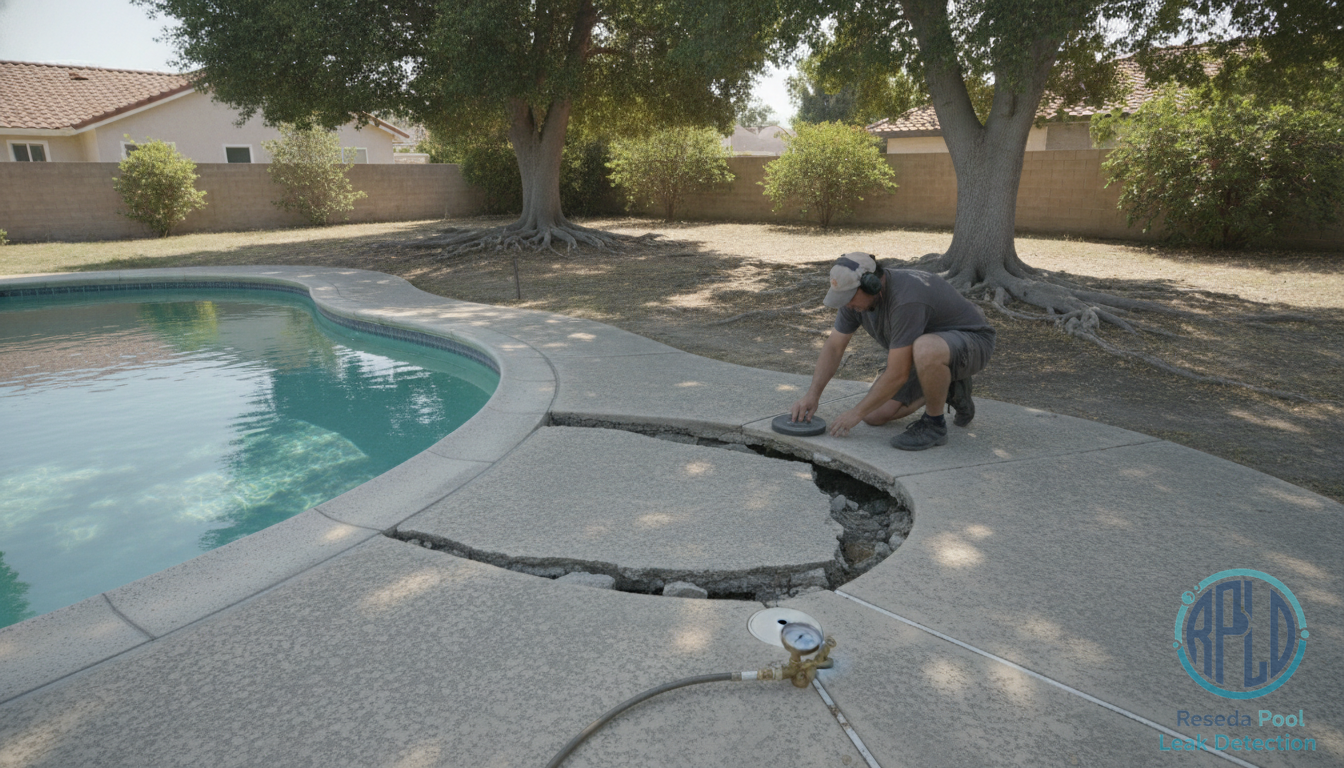
We plug each plumbing circuit at its access points and pressurize the line with air or water using a calibrated gauge. By testing each circuit independently — main drain lines, skimmer lines, return lines, cleaner lines, and spa plumbing — we can confirm exactly which pipe segment is losing pressure. A circuit that holds pressure is intact; one that bleeds down has a leak somewhere along its run. This tells us where to focus our acoustic equipment.
Step 2: Electronic Ground Microphone Listening
Once we've identified which circuit is failing, we deploy electronic ground microphones — highly sensitive listening devices that can detect the distinctive sound signature of pressurized water escaping through a pipe wall or joint underground. The technician moves methodically along the route of the pipe, listening for the amplified rush or hiss that pinpoints the leak location. This technology allows us to narrow the leak site to within inches on the surface above the pipe.
Step 3: Documentation and Repair Referral
Once the leak is located, we document its position using precise measurements from permanent reference points — pool edges, equipment pad corners, deck control joints — so any repair crew can excavate with confidence and open only the minimum necessary area. We walk you through the findings, explain the probable cause, and discuss repair options so you understand exactly what you're facing.
What Happens If You Ignore an Underground Leak
Many pool owners delay leak investigation because the problem isn't visible. This is understandable but costly. An underground plumbing leak that loses just a few gallons per hour will:
- Add hundreds of dollars to your annual water bill
- Saturate and soften the soil beneath your pool deck, leading to cracking, settling, and lifting of concrete slabs
- Undermine the equipment pad foundation, causing the pad to tilt and stressing the plumbing connections on top of it
- Accelerate erosion of the soil supporting the pool shell, increasing the risk of structural movement and shell cracking
- Create conditions for root intrusion and ongoing pipe degradation
Serving Reseda and the West San Fernando Valley
Reseda Pool Leak Detection provides pool plumbing leak detection in Reseda and throughout the San Fernando Valley, including Canoga Park, Winnetka, Northridge, and beyond. We're available Monday through Sunday, 8 AM to 6 PM, and can often schedule same-day or next-day appointments to minimize ongoing damage. Call (747) 351-0123 to schedule your plumbing leak inspection.