Why Skimmers and Light Niches Leak So Often
Ask most pool owners where they think their pool is leaking, and they'll point to the shell, the plumbing, or the equipment. Rarely does anyone suspect the skimmer or the pool light. Yet these two components consistently rank among the most common sources of water loss in residential pools throughout Reseda, Tarzana, Encino, and the surrounding San Fernando Valley communities we serve.
The reason comes down to materials and mechanics. Skimmer bodies are typically made from ABS plastic, while the pool shell surrounding them is gunite — concrete. These two materials expand and contract at different rates as temperatures change through the seasons. Over years of thermal cycling, the bond between the plastic skimmer throat and the surrounding concrete shell fatigues and eventually separates, creating a gap right at the waterline where the pool loses water continuously. Similarly, pool light niches are fiberglass or plastic housings cast into the concrete shell, and the same bond-fatigue process eventually opens a pathway for water to escape.
Our skimmer and light niche leak detection service is specifically designed to find these hidden failure points using dye testing and pressure isolation — with no guesswork required.
How a Skimmer Leak Behaves
A classic tell-tale sign of a skimmer leak is that your pool loses water to a specific level and then stops — or loses water much faster when the pump is running than when it's off. Here's why: the skimmer throat is located at the waterline. If the bond between the skimmer and the shell has separated, water will drain through that gap until the water level drops below the point of separation. Once the water level is below the leak, the loss stops. Many pool owners notice their water stabilizes at a level just below the bottom of the skimmer opening and assume the leak has mysteriously resolved itself — it hasn't. It's simply waiting for the pool to be refilled.
A useful field check is to plug the skimmer line using a test plug and observe whether the pool stops losing water. If the rate of loss drops significantly after plugging the skimmer, the leak source is in the skimmer area. Our technicians can then use dye testing to pinpoint whether the failure is at the throat joint, the plumbing connection below the skimmer, or the skimmer body itself.
How a Light Niche Leak Behaves
Pool light niches present a different challenge. The niche housing is recessed into the pool wall below the waterline, and water can escape through cracks in the niche itself, through the conduit tube that runs from the niche to the junction box, or through a deteriorating seal between the niche flange and the surrounding plaster. Because the light niche sits below the surface, these leaks are difficult to spot visually and often go undetected for long periods.
Beyond water loss, a leaking light niche carries a safety concern: water that enters the conduit can travel to the electrical junction box, potentially compromising the waterproofing of the electrical system. We strongly recommend that any pool owner who suspects a light niche leak arrange for an inspection of the electrical components by a qualified electrician in addition to addressing the water leak itself.
The Dye Test: How We Confirm Skimmer and Light Niche Leaks
Dye testing is the most reliable and visual method for confirming active leaks at these components. Here's how it works in practice:
- The pool pump is turned off so the water is calm and undisturbed.
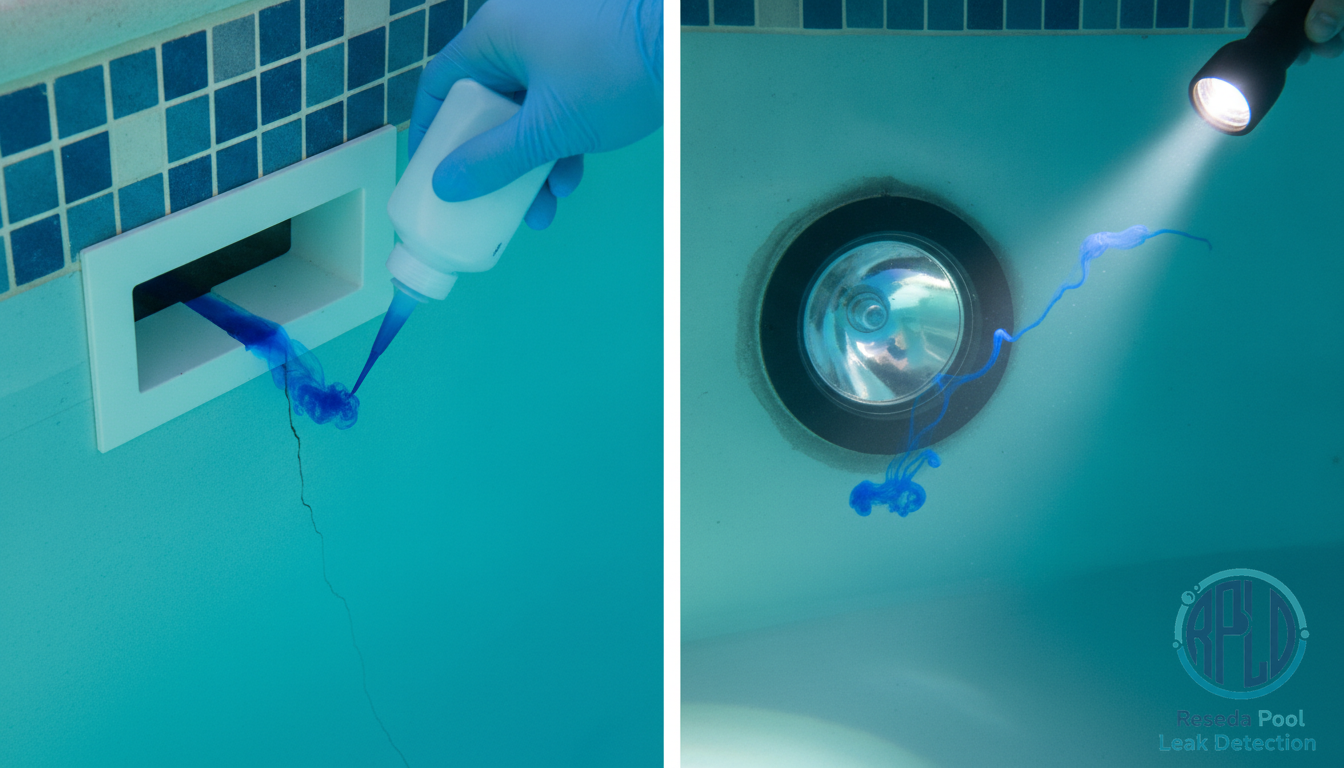
- A small amount of colored dye — typically a bright blue or red — is released from a squeeze bottle near the suspected leak point: along the edge of the skimmer throat, around the light niche flange, or at any fitting suspected of leaking.
- If the joint is actively leaking, the flowing water escaping through the gap creates a slight suction that visibly pulls the dye stream toward and into the crack or gap. The movement is clear and photographable, providing documented confirmation of the leak.
- Cosmetic surface marks that are not actively leaking will not pull the dye — the dye simply drifts away undisturbed, confirming the mark is not the source of water loss.
This approach saves homeowners from paying for repairs to the wrong area, and gives them clear documentation of exactly what was found and where.
Repair Options for Skimmer and Light Niche Leaks
The good news about skimmer and light niche leaks is that they often don't require draining the pool. Depending on the severity and location of the failure:
- Skimmer throat separation: Many skimmer-to-shell joint failures can be sealed with two-part underwater epoxy putty applied at the waterline with the water level only partially lowered. In cases where the skimmer body has cracked or degraded significantly, a replacement skimmer unit may be the more durable long-term solution.
- Light niche leaks: Minor niche flange separations can often be addressed with hydraulic patching compounds. Cracked niche housings may require niche replacement. Either way, the work is typically localized and does not require full pool dewatering.
We document all findings with measurements and photographs so you understand exactly what was found, where it is, and why the recommended repair is appropriate. See also our related services for pool shell crack detection and repair and comprehensive pool leak detection if the skimmer or light niche assessment reveals additional concerns.
Serving Reseda, Northridge, Winnetka, and Beyond
Reseda Pool Leak Detection performs skimmer and light niche inspections seven days a week throughout Reseda, Northridge, Winnetka, Tarzana, Encino, and Canoga Park. If your pool is losing water and you haven't been able to identify the source, the skimmer and light niche are two of the first places we look — because in our experience, they're two of the most frequently overlooked. Call us at (747) 351-0123 to schedule a same-week inspection, or visit our Reseda skimmer and light niche leak detection page for more information.